

Why is bathing hard after a hip or knee replacement?
A regular bathtub asks you to do the three things a new joint finds hardest: lift one leg high over a wall, bend deeply to sit low, and push yourself back up from that low position while wet. Each of those moves loads the new hip or knee at an awkward angle, and each happens on a slippery surface. That is why rehab programs spend time teaching tub transfers before you go home.
The published guides agree on the basic idea. MedlinePlus, the National Library of Medicine's patient site, tells people with a new hip to keep their hips higher than their knees when sitting, to avoid bending the hip past 90 degrees, and not to sit down in the bottom of a regular bathtub. Instead it suggests standing in the shower or using a tub seat or stable plastic chair, a rubber mat, and a long-handled sponge.
The American Academy of Orthopaedic Surgeons gives similar home-preparation advice in its total hip replacement guide: securely fastened grab bars or handrails in the shower or bath, a sturdy shower bench or chair, an elevated toilet seat, and a long-handled sponge and shower hose. It notes that a fall during the first few weeks can damage the new hip, and that sitting and bending precautions usually apply for about the first six weeks.
What do knee replacement guides say about tubs?
Knee guides focus more on the wound and on getting up. The MedlinePlus knee replacement discharge sheet tells patients not to soak in a bathtub, hot tub or swimming pool, and to put hand rails and a slip-proof mat in the tub or shower. The AAOS total knee replacement guide adds that you should not soak the wound until it has fully sealed and dried, and suggests a chair 18 to 20 inches high, with a firm seat, firm back and two arms, during early recovery.
Alberta Health Services' knee replacement personal-care guide is more specific about the bathtub: it says not to sit in the bottom of the tub for about three months after surgery, and to wash on a bath seat in the tub or a chair in a walk-in shower, with someone helping you in and out until you can do it safely alone. Hospital for Special Surgery's tub bench guidance recommends a tub bench until your knee mobility returns, practiced first with your home physical therapist.
How do these rules translate into a bathing plan?
Put together, the guides describe a recovery in stages. The exact timing is your surgeon's call, but the shape is consistent.
| Stage | What the guides emphasize | Bathing setup to consider |
|---|---|---|
| Before surgery | Prepare the home: grab bars, shower bench or chair, raised toilet seat, clear paths (AAOS) | Install grab bars, get a tub bench or shower chair, plan your walk-in tub decision for later |
| First weeks home | Wound care, no soaking, hip precautions, help with transfers (MedlinePlus, AAOS) | Sponge bath or seated shower on a tub bench, with someone nearby |
| Up to about 3 months | For knees, no sitting in the bottom of a tub (Alberta Health Services); keep hips above knees for hips (MedlinePlus) | Seated shower; practice tub transfers with your therapist |
| Cleared by your surgeon | Return to normal activity at the pace your team sets | A walk-in tub with a seat at the right height, or a roll-in shower if you prefer |
Notice where a walk-in tub fits: it is a long-term answer, not a recovery tool. You will spend the early weeks on a bench or a shower chair whatever you buy, so there is time to choose carefully. Many people find it useful to install grab bars and a handheld shower before surgery and leave the tub decision until they know how the new joint moves.
What seat height do I need?
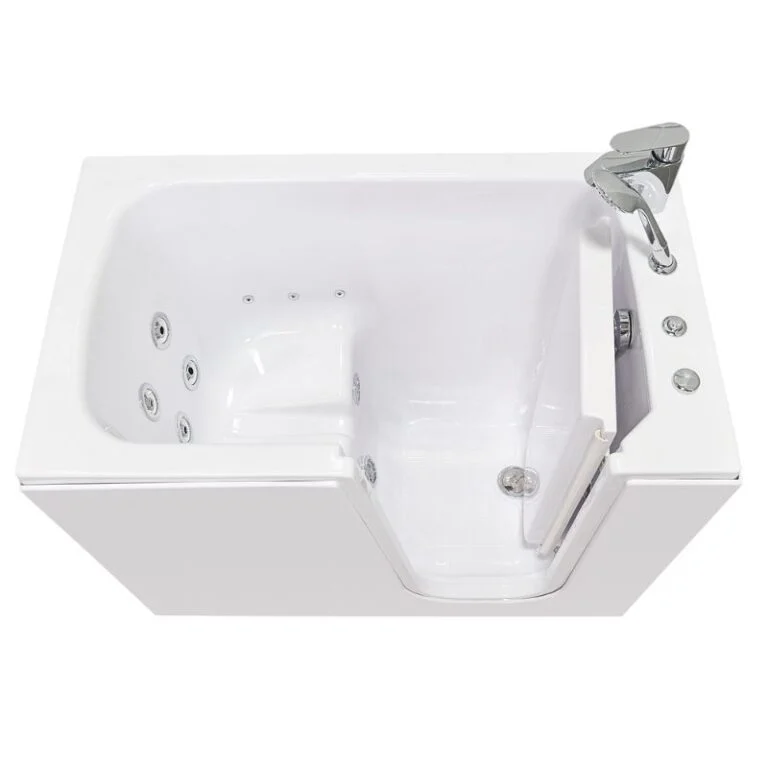
Seat height is where a walk-in tub can genuinely help after a joint replacement. A regular tub puts you on the floor; a walk-in tub puts you on a built-in seat at roughly chair height. The question is whether that seat is high enough for your hips to stay above your knees and for you to stand up without straining the new joint.
Two reference ranges are useful. The 2010 ADA Standards set the top of bathtub seats at 17 to 19 inches above the floor (section 610.2). The AAOS suggests an 18 to 20 inch chair during early knee recovery. Your own number is the height of the chair you stand from most easily. Try the checker below, then compare your number with the seat height listed on each tub's spec sheet.
Seat-height checker
Measure from the floor to the top of the seat of the chair you stand up from most easily. Enter it here.
Your result will appear here.
Which way do I get in and out?
Technique matters as much as equipment. Hospital for Special Surgery's hip replacement tub guidance, written for one surgical approach, says the non-operated leg should ideally go in first and the operated leg should lead on the way out, keeping the thighs in line. HSS is careful to say the steps are specific to the surgical approach and should be approved by your surgeon. Other approaches have different precautions, so ask your therapist to show you the sequence that fits your surgery.
In a walk-in tub the same principle applies on a smaller scale. You still lift each leg over a threshold, just a much lower one, and you still turn and sit. Practicing that move once your team allows it, with someone nearby, tells you more than any brochure. For the general technique with stiff joints or shaky balance, see our guide to getting in and out of a walk-in tub safely.
What features help most after a joint replacement?
- The right seat height. High enough to keep your hips above your knees and let you stand without a hard push.
- A low step-in, or none. If lifting the operated leg is still hard, a transfer tub lets you slide in at seat height through an outward door.
- Grab bars where your hands land. One by the door for stepping in, one by the seat for standing up. Towel bars are not grab bars.
- A handheld shower. It lets you rinse while seated, before the tub drains, without twisting.
- Controls within reach of the seat. So you do not lean forward or bend past your limits to turn the water on.
- Room for a helper. Early on, someone may steady you. An outward door gives them space.
Hydrotherapy jets are a separate decision. Warm water feels good to many people with joint pain, but no guide we read says jets speed recovery from joint replacement, and soaking of any kind waits for your surgeon's approval.
Should I choose a walk-in tub or a shower?
If you enjoy baths and can manage a low step once you heal, a seated walk-in tub is a reasonable long-term choice. If you only shower, if both knees or hips are involved, or if you expect to use a walker for a long time, a low-threshold or roll-in shower with a seat may serve you better. Our walk-in tub fit check weighs your step, standing, bending and mobility answers and points to the type that fits, including when the answer is a shower. Aging Safely Baths' walk-in tubs for seniors page has the full range of seat and door options.
What should I ask my surgeon or therapist?
- When may I sit on a tub seat, and when may I soak?
- Which leg should lead getting in and out, for my surgical approach?
- How high should my seat be so I stay within my precautions?
- Are my precautions temporary, or should I plan for them long term?
- Would you recommend a home safety visit before I choose equipment?
Bring the answers when you call us at 1-888-779-2284. We will match them to real seat heights and step-ins, and if a tub isn't the right answer yet, we will say so. You can also browse walk-in tub models or return to the Senior Walk In Tub home page.
Medical note: This article summarizes publicly available patient education from MedlinePlus, the American Academy of Orthopaedic Surgeons, Hospital for Special Surgery and Alberta Health Services, checked October 22, 2026. It is not medical advice. Follow the instructions of your own surgeon and therapist.