

Why does neuropathy change how you should bathe?
Because the warning system you've relied on your whole life may not be working in your feet anymore. The National Institute of Diabetes and Digestive and Kidney Diseases (NIDDK) says that up to one-half of people with diabetes have peripheral neuropathy, and that it can cause problems sensing pain or temperature in the feet and legs. The same page notes it can make you more likely to lose your balance and fall.
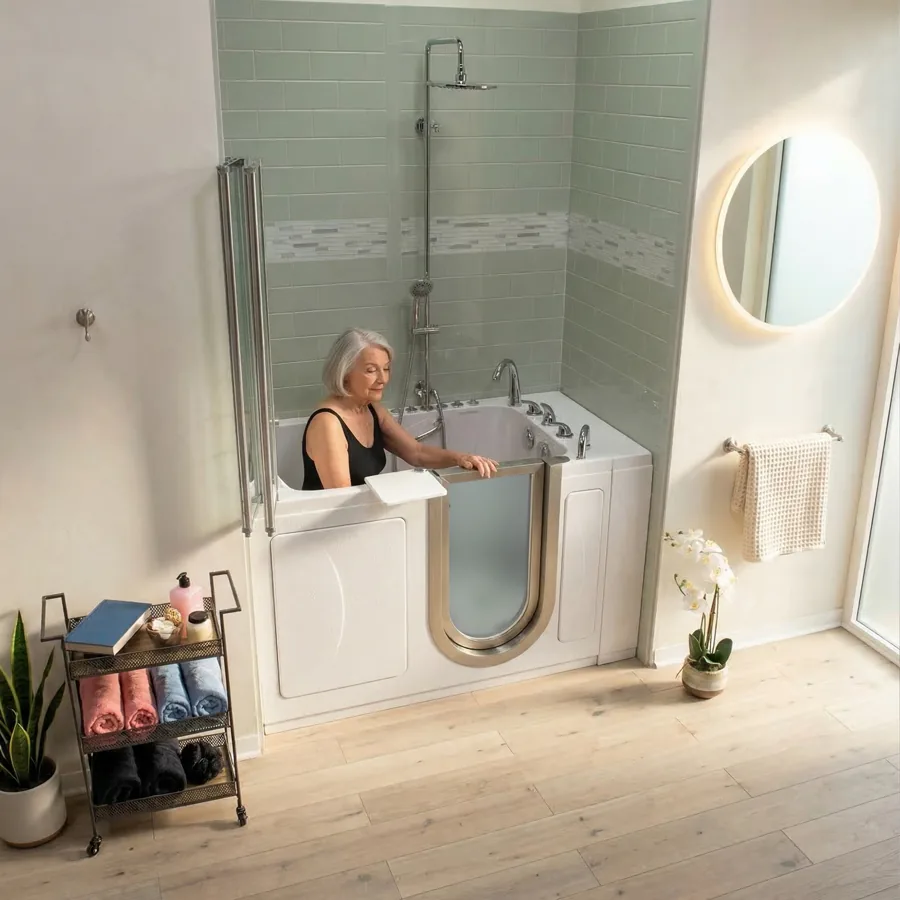
Put those two facts in a bathroom and you get the two risks this page is about. First, water that's too hot can burn skin that doesn't report the heat. Second, the moment you step in or stand up is when unsteady feet matter most. A walk-in tub helps with the second risk by design: you step over a low threshold instead of a high tub wall, and you sit on a seat instead of lowering yourself to the floor. The first risk is about how you set up and use the tub, and that part is up to you and your installer.
How hot should the bath water be?
Lower than you'd guess, and measured rather than felt. NIDDK's foot-care page tells people with diabetes to wash in warm, not hot, water and to test it first with a thermometer (it gives 90° to 95°F as safe) or your elbow. That figure is written for washing feet. For a full soak, plenty of people like it a little warmer, and that's exactly the conversation to have with your clinician before your first bath, because circulation, blood pressure and skin condition all play a part.
What isn't up for debate is the ceiling. The U.S. Consumer Product Safety Commission recommends setting water heaters to 120°F and publishes how fast hotter water burns an adult:
| Water temperature | Time to a serious burn | What it means for a walk-in tub |
|---|---|---|
| 150°F | About 2 seconds | Far too hot for any bathing; a water heater set this high is a hazard |
| 140°F | About 6 seconds | Common factory setting on some heaters; turn it down |
| 130°F | About 30 seconds | Still dangerous for skin that can't feel heat |
| 120°F | About 5 minutes | CPSC's recommended heater setting; bath water should still be mixed cooler |
Source: CPSC, "Avoiding Tap Water Scalds". The CPSC adds that most scald victims are older adults and young children. If you can't feel your feet, a five-minute margin at 120°F is the reason that setting matters: it gives you time to notice with a thermometer, your hands or your elbow before damage is done.
A cheap floating bath thermometer kept on the tub ledge is the single best purchase on this page. Check the water before you get in, and again if you add hot water while seated.
Which tub features help most with numb feet?
Think of the features in two groups: the ones that control water temperature, and the ones that keep your feet out of trouble while you get in and out.
- An anti-scald (thermostatic or pressure-balancing) mixing valve. It caps the outlet temperature so a sudden change in household water pressure, or a twist of the handle too far, can't send scalding water into the tub. Ask your installer what maximum temperature it's set to, and have them show you.
- Controls you can reach from the seat. You should be able to adjust the water without leaning forward or standing on wet feet.
- A handheld shower. Rinsing while seated, before you stand, means fewer trips up and down on feet you can't fully trust.
- A low threshold and a textured floor. Less lifting of each foot, and better grip where your feet land. Check the step-in height on the spec sheet, not the brochure.
- A grab bar by the door and one by the seat. One for stepping in, one for pushing up. Neuropathy affects balance, so your hands do more of the work.
- A seat at the right height. The 2010 ADA Standards put bathtub seats at 17 to 19 inches above the floor. If you stand most easily from a higher chair, ask for exact seat heights before you choose a model.
About heated extras: an inline heater keeps water at the temperature you started with as you soak; it doesn't make it hotter. Heated seats and backrests warm the surface you sit against. Both are comfort features, and with reduced sensation in your legs it's worth asking your clinician whether a warm surface against the skin for a long soak is a good idea for you.
Want help matching a tub to your feet and balance? Call 1-888-779-2284 (7am to 8pm Mountain, 7 days) or use the free quote form. Tell us what your feet, hands and balance are like and we'll match you to seat heights, controls and step-ins, or tell you honestly if a shower fits better.
How does a safe bath actually go, start to finish?
Most of the safety comes from a routine you repeat the same way every time. Here's one that works with how walk-in tubs fill and drain:
- Look at your feet before you start. NIDDK recommends checking your feet every day. If you see a blister, cut or open sore, ask your clinician whether soaking is okay until it heals.
- Sit down first, then fill. A walk-in tub fills while you're seated with the door closed. That's normal, and it's safer than standing on a wet floor while it fills.
- Check the temperature as it fills. Use the thermometer or your elbow, never your toes.
- Keep soaks reasonable. Long, very warm soaks can leave some people light-headed when they stand. Hot-tub safety guidance for people with diabetes commonly suggests limiting soaks to around 15 to 20 minutes; your clinician can tell you what suits you.
- Drain before you stand. The door on most walk-in tubs can't open until the water is out. Use the time to rinse with the handheld shower and let your circulation settle.
- Stand slowly, using the grab bar. Pause seated for a few seconds before you rise, then once more at the door before you step out.
- Dry well, especially between your toes. Then check your feet again in good light. A long-handled mirror helps.
Will a walk-in tub help with circulation or blood sugar?
You'll see that claim on some sales sites. We don't make it. Warm water feels good, and many people simply enjoy a seated soak again after years of avoiding the tub. That's a real benefit. But we haven't found solid evidence that a walk-in tub improves blood sugar or treats neuropathy, so please don't buy one for that reason. Buy it because it makes getting clean easier and safer for you, and keep managing your diabetes with your care team. No bathing product eliminates the risk of falls; products are designed to reduce risk when installed and used properly.
Is a walk-in shower a better choice for me?
Sometimes, yes. A walk-in or roll-in shower with a seat avoids soaking entirely, never asks you to wait for a drain, and is easy to step into. It suits you better if you don't actually enjoy baths, if you have frequent foot wounds your clinician wants kept out of standing water, or if you expect to use a walker or wheelchair. A walk-in tub suits you better if a warm seated soak is something you'd really use and you can manage a low step. Our walk-in tub fit check asks about your step, standing and balance and points to tub or shower. For getting in and out with unsteady feet, see getting in and out of a walk-in tub safely.
What about the water heater?
Two things to check. First, the setting: CPSC's 120°F recommendation is a good default, and many heaters ship set higher. Second, the size: a walk-in tub holds more water than people expect, and if the heater runs short partway through the fill you'll either get a lukewarm bath or be tempted to turn the heater up, which is the wrong fix. Aging Safely Baths has a detailed guide on sizing a water heater for a walk-in tub that walks through tank capacity and recovery. Ask your installer to confirm both before the tub goes in.
Questions to take to your doctor or podiatrist
- Is soaking okay for my feet right now, and how long is too long?
- What water temperature do you want me to stay under?
- Is my balance safe for stepping into a tub with grab bars, or should I start with a shower seat?
- Should I avoid heated seats or warm surfaces against my legs?
- Would an occupational therapist home visit help me plan the bathroom?
Bring those answers when you call. We'll translate them into a short list of tubs, or showers, that fit. You can also browse our walk-in tub models or read about bathing after a hip or knee replacement.
Ready to talk it through? Call 1-888-779-2284 (7am to 8pm Mountain, 7 days) or use the free quote form. Tell us what your feet, hands and balance are like and we'll match you to seat heights, controls and step-ins, or tell you honestly if a shower fits better.
Sources
- NIDDK, Peripheral Neuropathy (last reviewed February 2018), checked October 25, 2026
- NIDDK, Diabetes and Foot Problems (last reviewed January 2017), checked October 25, 2026
- U.S. Consumer Product Safety Commission, Avoiding Tap Water Scalds (Publication 5098)
- U.S. Access Board, 2010 ADA Standards, section 610 (seats)
Medical note: This page summarizes public information from NIH (NIDDK), the CPSC and the U.S. Access Board, checked October 25, 2026. It is not medical advice. Follow the guidance of your own doctor, podiatrist or diabetes educator.